Frequently Asked Questions

FAQS


The Wasoqonatl Transmission Initiative Incorporated (WTI) is a partnership created to plan, build, and deliver the NS–NB Reliability Intertie, a new transmission line that will strengthen electricity reliability and support Nova Scotia’s clean energy transition.
The project is delivered through Wasoqonatl Transmission Incorporated that includes a partnership between: 

  • Wskijinu’k Mtmo’taqnuow Agency (WMA) representing the 13 Mi’kmaw communities in Nova Scotia. 
  • Mi’gmaq United Investment Network (MUIN) representing the 9 Mi’gmag First Nations in New Brunswick. 
  • Canada Infrastructure Bank (CIB) 
  • Nova Scotia Power 
  • New Brunswick Power* 
*Non-financial partners 

Wasoqonatl is a Mi’kmaq word meaning “to illuminate” or “keep the light on.” The name reflects the project’s purpose and the central role of Mi’kmaw partners in shaping its direction. 

This project is working in partnership with all 13 Mi’kmaq communities in Nova Scotia through a collaborative engagement and participation model. This partnership ensures Mi’kmaq perspectives, rights, and traditional knowledge are reflected in every phase of the project. 

This project is working in partnership with all 9 Mi’gmag communities in New Brunswick through a collaborative engagement and participation model. This partnership ensures Mi’gmag perspectives, rights, and traditional knowledge are reflected in every phase of the project. 

This line will increase reliability for customers by providing a stronger connection to the inter-provincial power grid while supporting the expansion of renewable energy production like wind and solar.

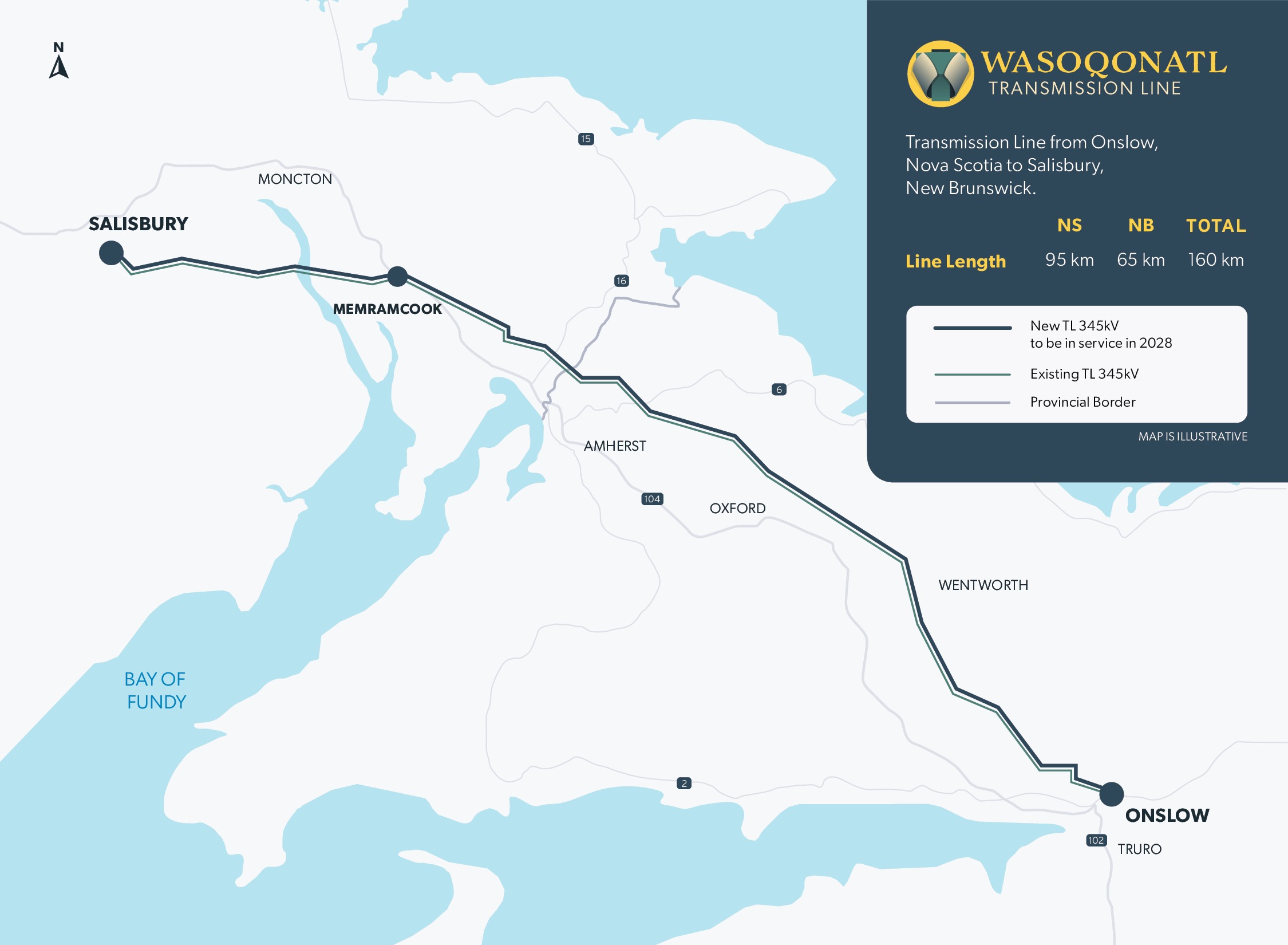
The Wasoqonatl Transmission Line is twinning an existing line to New Brunswick. The line will traverse approximately 160 km, from Onslow, Nova Scotia to Salisbury, New Brunswick.

Transmission Line Map

By strengthening the grid, the line allows supports for more renewable power, like wind and solar, to be added in the future.

Currently, we anticipate this project being in line service by end of 2028.   

Early vegetation work has begun, with full construction expected to start in 2026. The line is planned to be in service by the end of 2028.   

The new transmission line will follow parallel to an existing corridor and use existing access trails wherever possible to minimize new impacts. Property owners directly affected by construction will be contacted in advance. 

All work follows the project’s approved Environmental Assessment. Activities are planned to avoid sensitive wildlife periods, like migration and nesting, and environmental monitors are on site to protect habitats and waterways.

All construction activities are planned and scheduled to avoid sensitive wildlife periods, such as bird nesting and breeding seasons. Before any clearing begins, environmental specialists survey the area to identify and protect wildlife habitats. 

Following construction, access trails and work areas will be reinstated, vegetation growth will be managed, and sites will be restored to near‑original condition. 

Project updates will be shared regularly through community meetings, the project webpage, and direct emails. The Engage With Us page provides a way to contact the project team at any time.

Nearby residents may notice temporary traffic control, equipment noise, or changes to road access during construction. Efforts will be made to reduce disruptions and communicate any planned impacts ahead of time. 

Keeping people safe is a shared priority. All contractors are trained and work to strict safety standards, and residents are asked to avoid work areas while crews are on site. 

For project inquiries, updates, to share feedback, or ask a question, visit our Engage With Us page.